
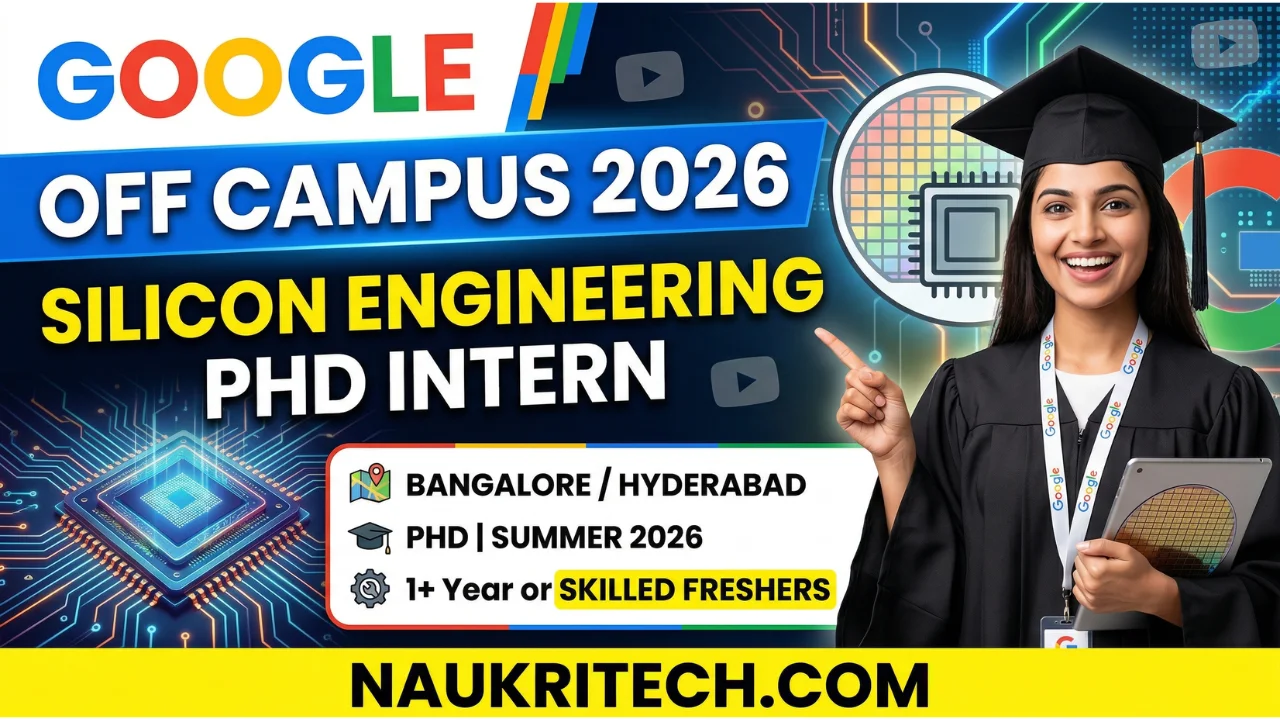
Google Off Campus 2026 : Google is officially inviting applications from top-tier researchers and doctoral candidates for its Summer 2026 Internship Program. They are actively hiring PhD students for the highly coveted Silicon Engineering Intern role, with placements at their major hardware engineering hubs in Bangalore and Hyderabad.
If you are pursuing a PhD in Computer Architecture, VLSI, or Electrical Engineering and want to help design the custom silicon that powers the world’s most advanced AI models and consumer devices, this is the pinnacle of hardware engineering internships.
About Google Custom Silicon :
Google is no longer just a search engine and software company; it is now a major player in the design of custom semiconductors. Google’s silicon team is pushing the limits of what hardware can do. They make the Tensor Processing Units (TPUs) that power Google Cloud and Gemini AI, as well as the Tensor SoC that powers the Pixel smartphone and Pixel Watch ecosystem.
Working as a Silicon Engineering Intern at Google means your research and designs will directly influence chips that operate at a massive, global scale. You will be working alongside industry veterans and renowned researchers to solve the most complex Power, Performance, and Area (PPA) challenges in the semiconductor industry.
Job Description :
You won’t be given boring, low-impact tasks as a Silicon Engineering Intern (PhD). Instead, you’ll be a key part of one of Google’s main hardware teams, like Architecture, RTL Design, Design Verification, or Physical Design.
| Company | |
| Role | Silicon Engineering Intern (PhD) |
| Location | Bangalore / Hyderabad, India (Hybrid) |
| Internship Period | Summer 2026 (Usually 12–14 Weeks) |
| Batch Eligible | PhD candidates graduating in late 2026 or 2027 |
| Expected Stipend | Highly Competitive (Industry Best for PhD Interns) |
Roles & Responsibilities :
Your responsibilities will depend on your area of expertise and the host you are matched with. They may include one or more of the following:
- Computer Architecture: Research and evaluate next-generation CPU, GPU, or Neural Processing Unit (NPU) architectures. Build cycle-accurate performance models using C++ to identify bottlenecks.
- RTL Design: Implement microarchitecture specifications into high-quality, synthesizable RTL code using SystemVerilog or Verilog.
- Design Verification (DV): Develop advanced testbenches, create constrained-random test cases, and achieve coverage closure using UVM (Universal Verification Methodology) or formal verification techniques.
- Physical Design & Power: Work on synthesis, place and route (P&R), static timing analysis (STA), and power/thermal optimization for advanced sub-nanometer technology nodes.
- Research Integration: Read cutting-edge academic papers and integrate novel hardware optimization techniques into Google’s existing silicon IP.
Education & Skills Required :
- Degree: Currently enrolled in a PhD program in Electrical Engineering (EE), Computer Engineering (CE), Computer Science (CS), or a related technical field.
- Target Batch: Students returning to their degree program after the completion of the Summer 2026 internship.
Core Technical Skills (Must-Have) :
- Hardware Description: Proficiency in SystemVerilog, Verilog, or VHDL.
- Programming & Scripting: Strong coding skills in C, C++, or Python (crucial for architectural modeling and scripting automation).
- Domain Expertise: Deep theoretical and practical knowledge in at least one core area: Computer Architecture, ASIC Design Flow, Logic Design, or Hardware Verification.
- Analytical Skills: Exceptional mathematical and problem-solving abilities to tackle unprecedented hardware scaling limitations.
Selection Process (How Google Hires PhDs) :
Google’s PhD hiring process is meticulous and highly focused on matching your specific research area with the right team.
- Resume & Portfolio Screening: Heavy emphasis on your PhD thesis topic, publications, and advanced hardware projects.
- Technical Phone Screens (1-2 Rounds): Deep technical discussions covering computer architecture fundamentals, digital logic, and coding (usually C++ or Python).
- Virtual Onsite Interviews (2-3 Rounds): Rigorous whiteboard (virtual) sessions solving complex ASIC design, RTL, or verification problems. You will also be asked to present your current PhD research.
- Host Matching: If you pass the technical bar, you enter the “Host Matching” pool. Managers across Google review your profile and interview you to see if your skills align with their specific Summer 2026 project. (An offer is only extended after a successful host match).

Frequently Asked Questions (FAQs) Google Off Campus 2026 :
1. Can B.Tech or M.Tech students apply for this specific role? No, this specific requisition is strictly for students currently enrolled in a PhD program. Google releases separate job links for BS/MS students.
2. What is the difference between a Software Engineering (SWE) and Silicon Engineering intern at Google? SWE interns work on Google’s software products (Search, Android, Cloud apps) using Java/Go/C++. Silicon interns work on the physical hardware chips (TPUs, Tensor) using SystemVerilog, C++ modeling, and EDA tools.
3. Does this internship lead to a full-time offer? Yes! Successful PhD interns are highly likely to receive a Full-Time offer to join Google as Hardware Engineers or Research Scientists upon completing their doctoral degree.
How to Apply for Google Silicon Engineering Intern 2026? :
Eligible PhD candidates should apply via the official Google Careers portal. Ensure your resume prominently features your GitHub (if applicable), publications, and detailed technical skills.
NaukriTech Pro Tip: For a PhD role at Google, your resume must clearly state your expected graduation date and your exact research domain. Brush up heavily on computer architecture fundamentals (pipelining, caches, out-of-order execution) before the first phone screen!